Evergreen
What Is Sim2Real in Robotics? How Robots Move from Simulation to Reality
Sim2Real describes the methods and evidence used to move a robot capability from a simulated environment to a physical one. This guide explains the reality gap, transfer strategies, and why simulation success alone is not deployment evidence.
- Published
- September 14, 2026
Key Takeaways
- Sim2Real is a transfer and validation problem, not a single algorithm.
- Visual appearance, dynamics, contact, sensing, timing, and embodiment can all differ between simulation and reality.
- Domain randomization, dynamics randomization, system identification, adaptation, and mixed sim–real data address different parts of the gap.
- Simulation benchmarks and real-world evaluation answer different questions.
- A learned policy, VLA model, or controller still requires hardware-specific safety and deployment evidence.
Introduction
A policy that succeeds in a simulator has not automatically learned how to operate a physical robot. Sim2Real names the transfer and validation problem that appears when a model, policy, representation, controller, or workflow moves from a simulated source domain toward a physical target system.
The topic sits inside the broader Physical AI stack, where perception, action, embodiment, hardware, and operating conditions meet. This article focuses on the simulation-to-reality boundary rather than on one model family.
What Does Sim2Real Mean?
Sim2Real is the set of methods and evidence used to move a robot capability from a modeled environment to a physical one. The transferred object may be a learned policy, a controller, a representation, a skill, model parameters, or a calibrated workflow. It is a task- and embodiment-specific relationship, not a single algorithm.
Source and target domains
The source domain is the simulator or other modeled setting in which a system is trained, tuned, or tested. The target domain is a defined physical robot operating with real sensors, actuators, objects, timing, and environmental variation. A meaningful claim names both domains and the task being transferred.
What Sim2Real is not
Sim2Real is not simulation itself, a synonym for robot learning, or a synonym for reinforcement learning. A simulator is a tool or environment, not proof that a policy worked on hardware. A digital twin may stay connected to a particular physical asset for monitoring, prediction, or decision support; those properties are not required for a Sim2Real result.
Why Is There a Simulation–Reality Gap?
Visual and sensor differences
Textures, lighting, camera models, occlusion, calibration, noise, exposure, and missing observations can differ between a rendered scene and a physical sensor. Visual similarity is only one part of transfer, and a policy can fail even when a scene looks convincing.
Dynamics, contact, and actuation
Mass, friction, compliance, backlash, actuator limits, latency, collisions, and contact transitions are difficult to model exactly. Contact-rich behavior can change when an object flexes, slips, or meets a surface at a slightly different angle. More simulator detail does not by itself remove these uncertainties.
Task, timing, and embodiment variation
Object placement, workspace layout, reset conditions, timing assumptions, morphology, and action interfaces can shift the target distribution. A result on one robot and one task should not be presented as evidence for every embodiment or environment.
The gap is therefore a set of task-dependent differences rather than one universal scalar. Its important dimensions depend on what the robot senses, how it acts, and what counts as success.
Why Use Simulation for Robot Learning?
Simulation can provide scalable and repeatable trials, faster iteration, parallel rollouts, parameter sweeps, and safer exploration than collecting every attempt on hardware. It can also make rare failures easier to reproduce and compare.
These benefits reduce iteration cost; they do not certify sensing, hardware reliability, safety, or real-world task performance. The simulator, task model, sensor model, dynamics, and evaluation protocol all determine what a simulation result actually says.
Main Sim2Real Transfer Strategies
Domain randomization
Domain randomization varies visual or environmental parameters during training so that the learner encounters a family of conditions rather than one polished scene. Its usefulness depends on whether the randomized family overlaps the target conditions. It is a robustness strategy, not a guarantee.
Dynamics randomization
Dynamics randomization varies physical parameters such as mass, friction, damping, motor strength, or delay. It can improve transfer for a bounded control task when the chosen range covers relevant behavior, but the result remains tied to the reported robot, task, and protocol.
System identification and calibration
System identification estimates robot or environment parameters from hardware observations, then uses those estimates to align the model and the physical system. Calibration can reduce mismatch in actuators, sensors, timing, or contact, while leaving unmodeled effects and changing environments unresolved.
Adaptation and representation transfer
Fine-tuning, residual models, feature alignment, online adaptation, and conservative policy updates can use target-domain evidence to manage mismatch. Adaptation may require real data and can introduce new failure modes, so it should be evaluated with explicit safety and rollback boundaries.
Mixed simulation and real data
Real data can complement simulation, especially for sensor characteristics, contact behavior, and embodiment effects. A small, carefully selected physical dataset may answer questions that a much larger simulated dataset cannot. More data alone does not imply automatic generalization.
Where Imitation Learning, Reinforcement Learning, and Generalist Policies Fit
Imitation learning
Demonstrations may be collected in simulation, by teleoperation, or on hardware. A learner can still encounter states unlike its demonstrations, so distribution shift remains relevant. Interactive relabeling methods such as DAgger are one response, not a requirement for every system.
Reinforcement learning
Reinforcement learning can exploit simulation at scale, but a high simulated reward may reflect simulator-specific shortcuts. Reward design, exploration, and the target-domain evaluation remain separate questions.
Generalist policies and VLA models
Generalist policies and vision-language-action models can be the object being transferred, a source of representations, or part of a system that mixes simulated and physical data. They are model or policy choices around robot action, not automatic Sim2Real methods.
For the broader acquisition question, see How Do Robots Learn?. Robot Learning is a wider method area that includes simulation, imitation, reinforcement, offline, model-based, and hybrid approaches.
Simulation Success vs Real-World Evaluation
Simulation success is simulation evidence. A benchmark, a controlled hardware trial, repeated evaluation in a changing physical environment, a bounded pilot, and sustained production operation answer progressively different questions and should be reported separately.
An evidence ladder
A useful reporting ladder can name the evidence without implying that every project must reach the final level: simulation-only result; controlled hardware test; repeated real-world evaluation; bounded pilot; or sustained operation with information about interventions, safety, failures, and time horizon.
A credible transfer report identifies the robot, task, initial conditions, environment variation, number and type of trials, intervention policy, failure handling, and what was not tested. The evidence is strong only within those boundaries.
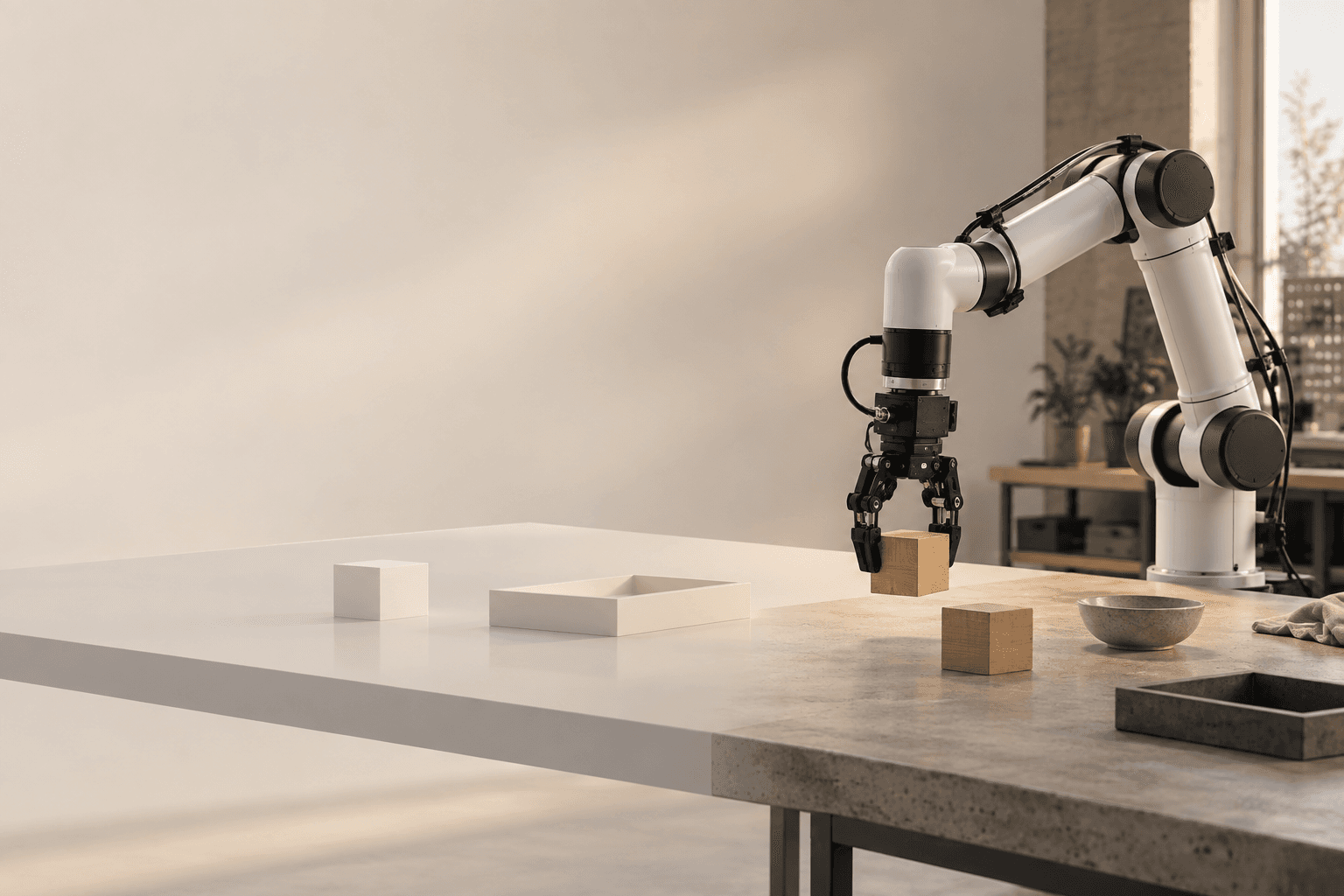
The same robot task can meet different conditions in a simulated and a physical environment. Sensing, dynamics, contact, timing, object properties, and embodiment may change; Sim2Real is the work of transferring and evaluating behavior across that gap, not a guarantee that simulation success will repeat on hardware.
Sim2Real Compared with Related Terms
Robot Learning
Robot Learning is the broader field of acquiring or improving robot behavior from data, demonstrations, interaction, or simulation. Sim2Real is a transfer concern that can appear inside several learning workflows, including imitation, reinforcement, supervised adaptation, or hybrid systems.
VLA
A VLA may be one component in a transfer workflow, but it is not equivalent to Sim2Real. For a model-family boundary, compare What Is VLA?. The model name does not establish where its data came from or whether a physical transfer was demonstrated.
Digital twins
A digital twin commonly maintains a relationship to a particular physical asset and may support monitoring, synchronization, prediction, optimization, or decision support. Sim2Real can use a simulator without those properties, so the terms should not be substituted for one another.
Representative Research Examples
CAD2RL illustrates visual-domain transfer from synthetic training toward a defined real-world task. Dynamics-randomization work shows how varying physical parameters can support a bounded physical-robot result. Dactyl and quadruped locomotion studies show that transfer behavior depends on the embodiment, task, and evaluation setup.
These are research demonstrations, not evidence that one recipe works across all robots. Tool pages for MuJoCo or Isaac Sim explain simulator capabilities; they do not, on their own, establish a transferred policy.
Limitations and Open Questions
Open questions include selecting randomization ranges that reflect target conditions, measuring contact and latency mismatch, collecting safe and representative real data, adapting without destabilizing a policy, and comparing results across embodiments. Long-horizon reliability and failure reporting remain as important as headline success rates.
Deployment claims need more than a benchmark or a short lab demo. Operating context, repeatability, human intervention, safety boundaries, recovery behavior, maintenance, and time horizon determine how much a result says about sustained use.
Conclusion
Sim2Real is best understood as a transfer and evidence problem at the boundary between a modeled world and a physical one. It sits within the Embodied AI perspective, while remaining distinct from Robot Learning, VLA, and digital-twin terminology. Domain randomization, dynamics randomization, calibration, adaptation, and mixed data are tools for managing a task-specific gap; real-world evaluation is what establishes how far a capability actually transferred.
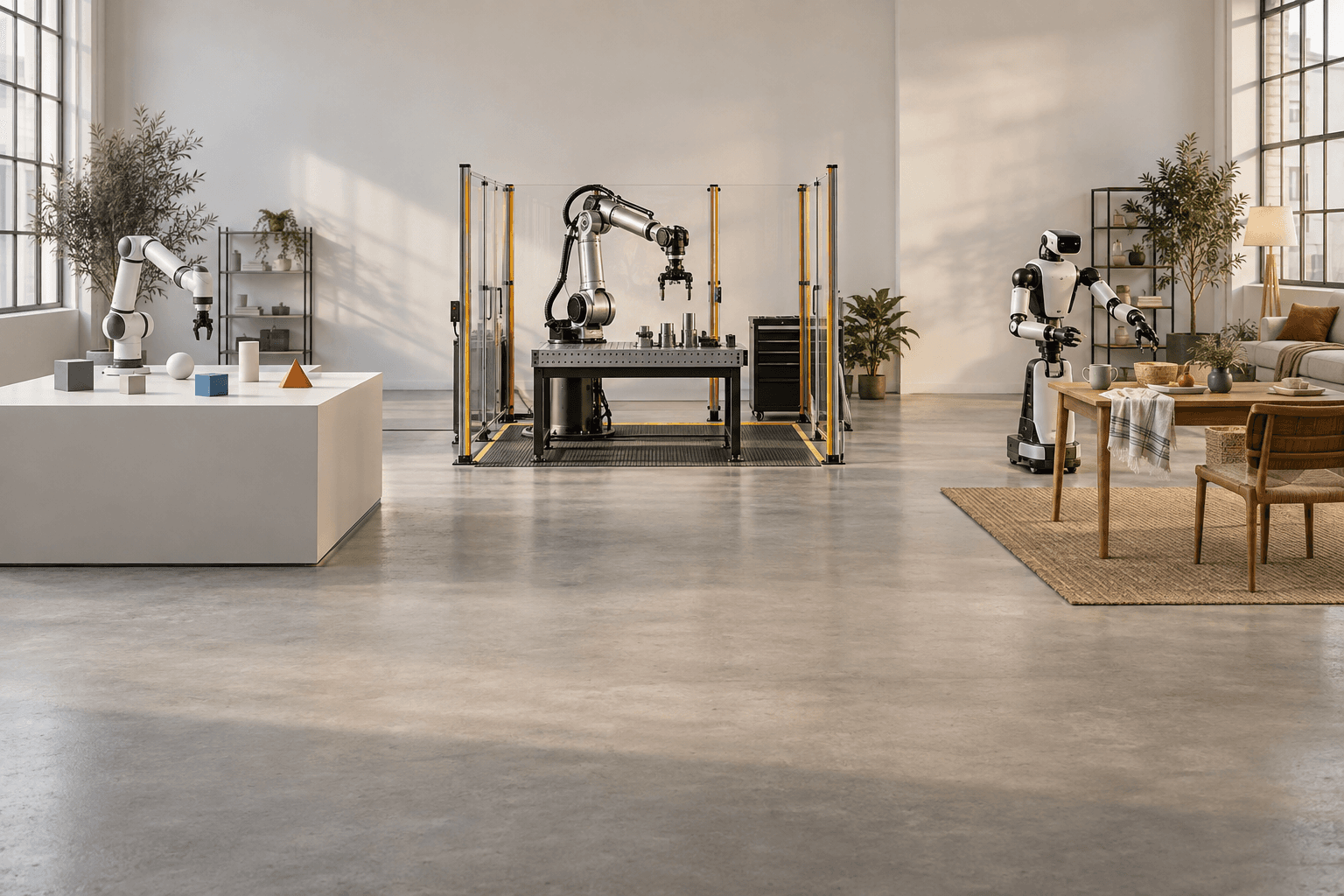
Robot evidence can be reported in different contexts: a simulation result, a controlled hardware test, and repeated real-world evaluation. These are parallel evidence contexts in an open relationship; they do not define a required route or maturity ranking. The strength of a claim depends on the task, hardware, protocol, failures, and the scope of what was actually tested.
These anchors identify parallel evidence contexts in an open relationship; they are not a required route.
- 01Simulation
- 02Controlled Hardware
- 03Real-world Evaluation