Evergreen
How Does Robot Manipulation Work? From Perception and Planning to Control
Robot manipulation is purposeful physical interaction with objects and environments. This guide uses peg insertion to explain task-relevant state, grasping, planning, contact, control, feedback, learning-based methods, and the evidence needed beyond a lab demonstration.
- Published
- September 15, 2026
Key Takeaways
- Robot manipulation describes a physical task and system problem; it is broader than grasping and is not synonymous with Robot Learning or VLA.
- A robot needs a task-relevant estimate of objects, its own state, contact, and uncertainty; no fixed sensor list works for every task.
- Task planning, contact/grasp choices, motion planning, trajectory generation, and control answer different questions and may be integrated or interleaved.
- Contact, friction, compliance, occlusion, and timing make insertion and other contact-rich tasks sensitive to small errors; force, tactile, and visual feedback can both expose and help manage that uncertainty.
- Grasp or benchmark success is not the same as whole-task success or sustained deployment evidence.
Introduction
Robot manipulation asks how a robot changes or maintains an object or part of its environment through purposeful physical interaction. A gripper can close successfully and still miss the hole; the difference between a local action and a task outcome is the systems problem this article frames.
It is a concrete instance of how models meet physical action. The site’s broader Physical AI question becomes specific here: a robot must estimate what matters, choose an interaction, move through a constrained workspace, and respond to what contact reveals. Perception, planning, control, and learning may be modular, learned, hybrid, or interleaved; the familiar decomposition is useful vocabulary, not a mandatory pipeline.
A single worked example—peg insertion—keeps the discussion concrete. It shows why manipulation is broader than grasping, why contact changes the problem, and why a good laboratory result is only one kind of evidence.
What Does Robot Manipulation Mean?
Purposeful physical interaction
Robot manipulation is purposeful physical interaction that changes or maintains the state of an object or environment. The purpose can be to place, push, slide, insert, fold, turn, or use a tool. These are representative task families, not a promise that one robot or gripper can perform all of them.
Manipulation and locomotion are related but different questions
Locomotion mainly changes the robot’s own pose, while manipulation mainly changes an object or the environment through contact. A mobile manipulator can do both at once, so the distinction is functional rather than a division between hardware types.
Related terms
Grasping is an important prehensile subproblem, but it is not a synonym for robot manipulation. Motion planning can produce a collision-free path without establishing useful object contact. Robot Learning concerns how a capability is acquired or improved, while Robot Manipulation names the physical task and system objective. A VLA can be one policy family that conditions actions on vision and language; it is not the complete manipulation stack.
A Worked Example: Peg Insertion
Consider a robot asked to insert a peg into a receiving hole. A successful attempt must bring the peg and fixture into the right relative configuration, establish a useful contact, maintain that contact while forces and friction change, and satisfy a task-level success condition such as the peg being seated. The exact predicate belongs to the task and evaluation protocol.
This example is deliberately not a controller-tuning tutorial. It is a compact way to see several coupled questions: what the robot can observe, how it chooses a grasp and approach, how it plans motion around geometry, how it reacts when contact is different from the estimate, and how success is measured.
What State Does the Robot Need?
Observation is not the same as task-relevant state
A camera frame is an observation, not automatically the state needed to act. A manipulation system maintains some task-relevant estimate or belief about the robot, objects, environment, contact variables, and uncertainty. That representation can be explicit, latent, or learned; it does not require a complete world model.
Vision, proprioception, force, and touch
Depending on the task, useful inputs may include object detection or segmentation, depth or 3D geometry, pose, proprioception, force-torque sensing, and tactile sensing. These modalities are complementary: each has different visibility, locality, noise, and timing. No fixed sensor list works for every manipulation problem.
Grasping Is Only One Part of Manipulation
What a grasp can establish
A grasp can establish a useful contact geometry and support an object while it is moved. Grasp analysis may use concepts such as force closure (resistance to a range of external wrenches under assumptions) and form closure (geometric constraint of motion). These are analytical properties of a contact arrangement, not guarantees about a later task.
What a grasp does not guarantee
A stable grasp does not by itself guarantee alignment, insertion, placement, collision avoidance, or whole-task success. A peg can be held securely and still approach the hole with the wrong pose, encounter unmodelled contact, or fail the task predicate.
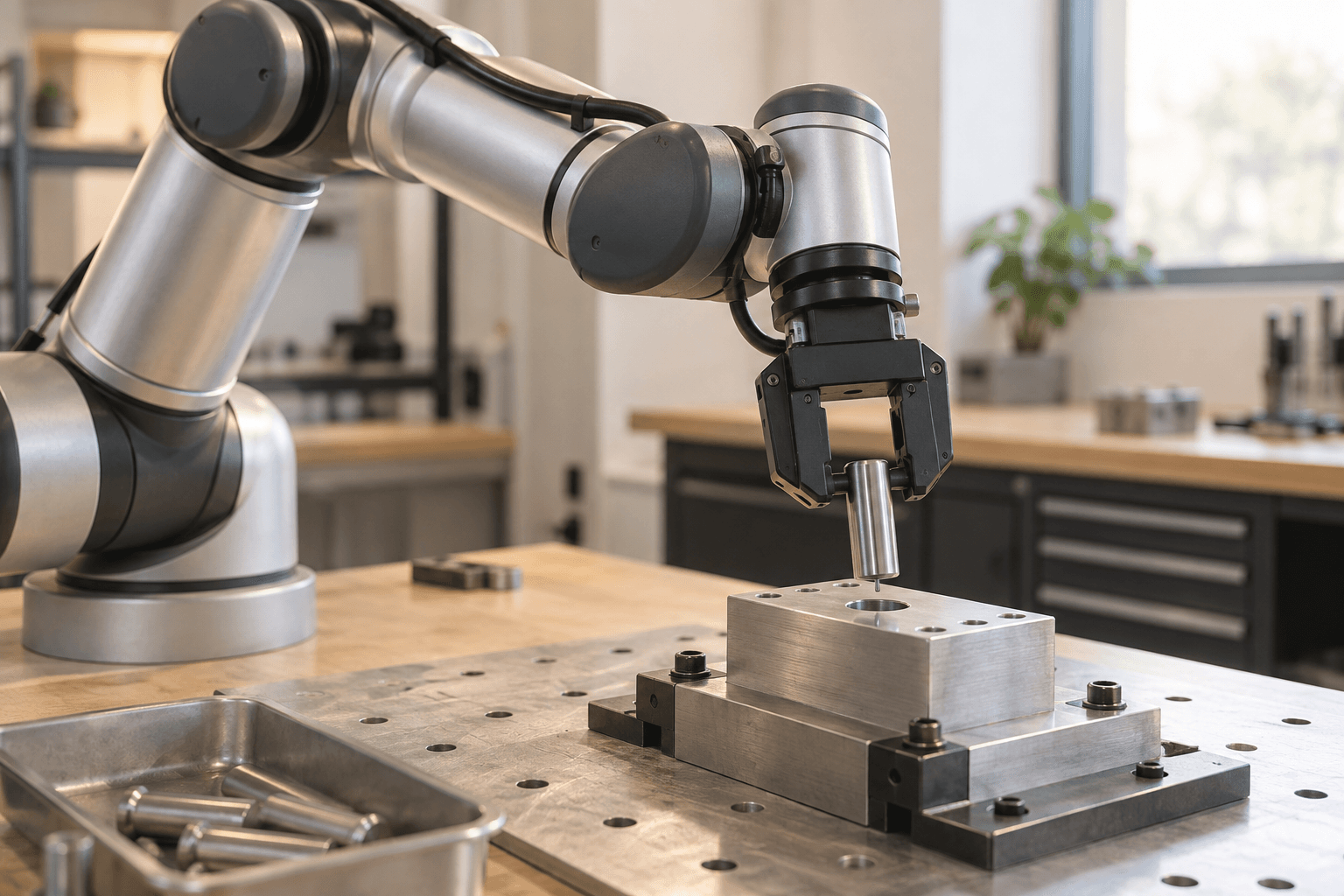
Robot manipulation includes the physical interaction needed to change an object or environment. Grasping is one primitive; task success depends on what happens as the robot aligns, contacts, supports, and responds to the world around it.
Planning Actions and Motion
Task, contact, motion, and trajectory planning
Task planning asks what goal or subtask should be pursued. Grasp or contact planning asks how the robot should establish and use physical interaction. Motion planning asks whether a geometric and kinematic movement is feasible. Trajectory generation adds timing and smoothness. These questions can be combined, separated, or revisited; there is no required perception → planning → control order.
Replanning under uncertainty
When an object pose, contact location, or collision margin differs from the estimate, a system may update its state estimate, choose another contact, alter the approach, or replan motion. Replanning is a strategy for responding to uncertainty, not a promise that every failure can be repaired.
Why Contact Changes the Problem
Friction, compliance, tolerances, and hidden contact modes
Free-space motion is only part of insertion. Friction, clearances, compliance, occlusion, timing, and unmodelled dynamics can change the outcome when surfaces meet. Small errors in pose or timing can switch a peg from sliding into binding, or from a useful contact to an unstable one.
Contact is both disturbance and information
Contact can disturb the planned motion, but it can also reveal information about the task. Force and touch readings may expose a surface, a collision, or a change in constraint. This is one reason body–environment interaction matters: the physical response is part of the evidence available to the system, while remaining local and noisy rather than a complete solution to uncertainty.
Control, Compliance, and Feedback
From action references to actuator behavior
Controllers convert higher-level motion or force references into actuator behavior while respecting dynamics, limits, and feedback. Position, velocity, torque, impedance, force, operational-space control, and hybrid position/force control are different formulations or interfaces. None is a universal maturity ranking.
Why compliance can help during insertion
Compliance shapes how a robot responds when an environment pushes back. An impedance or force-related controller can allow a small positional error to produce a bounded interaction response rather than a rigid collision. The benefit depends on the robot, sensing, controller design, and contact conditions; compliance is not a guarantee of insertion.
Feedback can change the plan
Feedback may update the state estimate, alter the chosen motion or contact, or change the controller response. In a peg task, a force transient can be evidence that the current alignment is wrong; the next response might be a slower approach, a pose adjustment, or a new attempt. The relevant relationship is closed-loop interaction, not a fixed sequence of boxes.
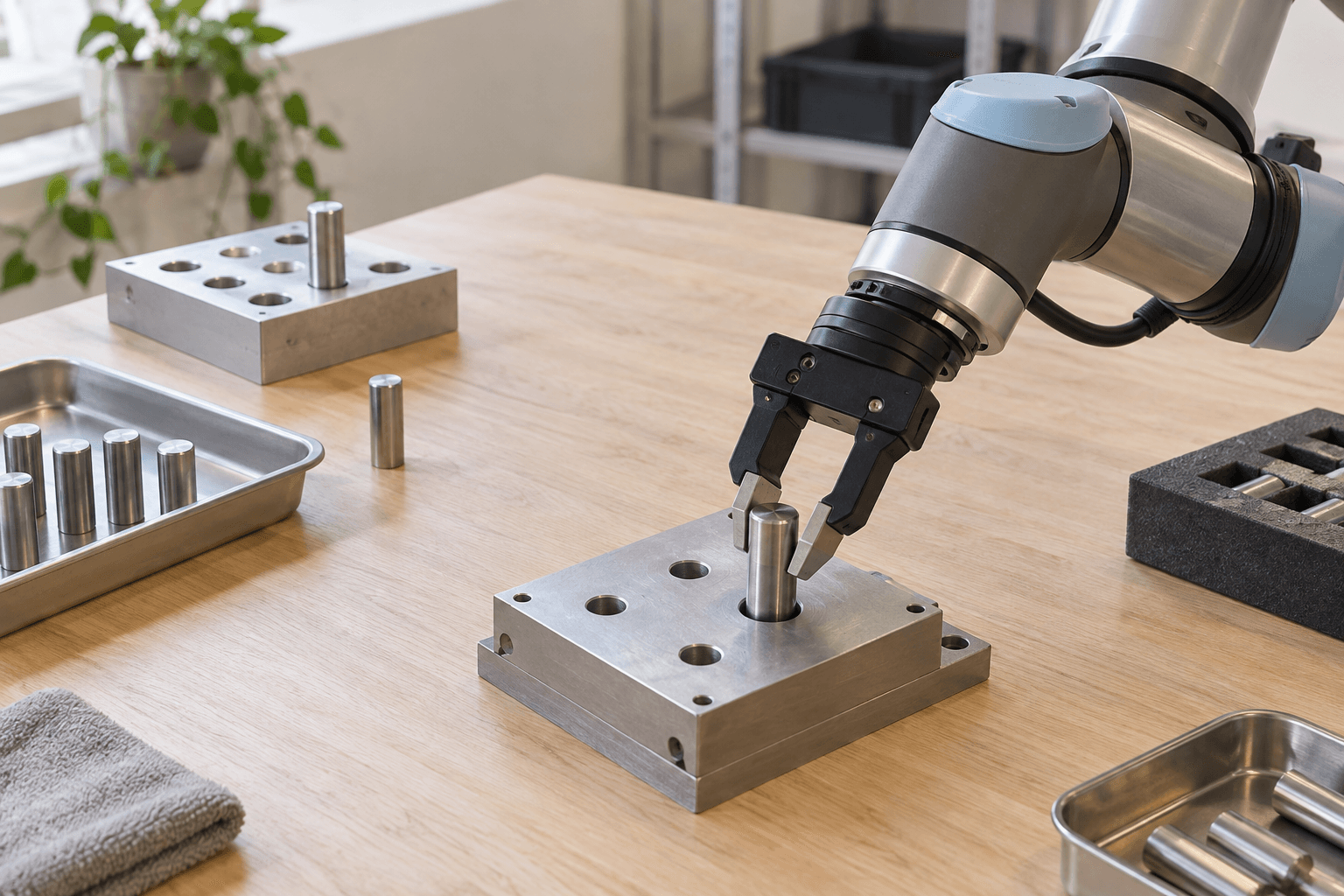
Manipulation brings task-relevant state, action and motion, and contact and feedback into an ongoing physical relationship. Feedback can change what the robot estimates, how it moves, or how it responds to contact; implementations may combine these functions in different ways.
These are interacting functions rather than one required technical order. Different systems may separate, combine, or learn them in different ways.
- 01Task-relevant StateObjects, targets, contact cues, and uncertainty that matter for the task.
- 02Action and MotionPhysical movement and action choices in the current workspace.
- 03Contact and FeedbackInteraction can reveal uncertainty and reshape the next response.
Where Robot Learning and VLA Fit
Learning can enter different parts of a manipulation system
Learning can contribute to perception, grasp proposals, dynamics estimates, policies, or control. The question of how a robot acquires a capability is therefore related but distinct: Robot Learning names methods for acquiring or improving behavior, while manipulation names the physical objective and constraints.
Robot Manipulation vs Robot Learning
A learned policy can be used inside a manipulation system, and a manipulation task can be solved with little or no learned component. Training success is not the same as reliable execution, and a capable controller does not explain how a policy was learned. Keeping these scopes separate prevents “robot manipulation” from becoming a survey of learning algorithms.
Robot Manipulation vs VLA
A VLA model can condition an action representation on visual and language inputs. It can be one layer in a system that still needs state estimation, contact handling, motion constraints, low-level control, safety logic, and evaluation. The relevant question is where a VLA policy can enter manipulation, not whether VLA is a complete manipulation stack.
How Manipulation Is Evaluated — and Why Lab Success Is Not Deployment
Metrics answer different questions
A grasp-success metric, a pose error, an insertion predicate, a collision count, and a completion rate measure different parts of the problem. The task, object set, robot, horizon, intervention policy, and success definition must be stated before results can be interpreted.
Evidence categories
Evidence can come from simulation, a benchmark, a controlled hardware study, repeated hardware trials, a pilot, or sustained operation. Each category answers a different question. A simulation benchmark can expose task diversity; a physical benchmark can expose contact and hardware variation; neither alone is a deployment certificate.
Why lab success is not deployment
A successful demonstration or benchmark result is bounded evidence under a reported setup. It does not establish reliability across environments, objects, maintenance conditions, or operating policies. This is why why manipulation must be tested beyond simulation is a separate question from whether a controller or policy works in one experiment.
Limitations and Open Problems
Generalization, contact sensing, and safe recovery
Open problems include representing uncertainty without overclaiming a complete state, sensing contact when visibility is poor, adapting to changing friction and tolerances, and recovering safely when the intended interaction fails. These challenges appear in arms, hands, mobile manipulators, and other embodiments; a humanoid form is not a prerequisite.
Dexterity and bimanual coordination are useful boundary examples rather than automatic proof of general manipulation ability. More joints or a single successful demonstration does not by itself establish robust, repeatable task performance.
Conclusion
Robot manipulation is the study and engineering of purposeful physical interaction. Peg insertion makes the boundary clear: perception must be task-relevant, grasping is only one subproblem, planning and control answer different questions, and contact provides both uncertainty and information. Learning and VLA can contribute at different points, but neither erases the need for physical evidence. The most useful conclusion is therefore modest: a manipulation claim is only as strong as the task definition, feedback conditions, and deployment evidence behind it.