Evergreen
What Is a Vision-Language-Action Model?
A clear guide to how Vision-Language-Action models connect language, vision, and robot behavior—and where they fit within a larger control stack.
- Published
- September 2, 2026
- Content updated
- September 1, 2026
- Last verified
- September 1, 2026
Key Takeaways
- VLA connects language and visual observations to a robot action representation.
- An action representation may be a token, pose, waypoint, trajectory, or action vector—not necessarily motor torque.
- VLA is one learned layer in a system that still needs planning, control, actuation, and safety.
Introduction
A robot may receive an instruction in language and observe a scene through cameras, but neither input alone is enough to complete a physical task. The system must connect what a person means, what the robot sees, and what the robot can do.
A Vision-Language-Action model, or VLA, is a model family built for that connection. It can add a learned policy layer to the broader Physical AI stack; it does not replace planning, feedback control, actuation, or safety systems.
What Does VLA Mean?
Vision
Vision refers to observations of the physical scene: objects, surfaces, obstacles, people, the robot body, and the workspace. Inputs may come from RGB, depth, wrist-mounted, or other sensors.
Language
Language expresses a task, goal, constraint, or correction, such as “pick up the red block and place it in the tray.” It gives people a flexible interface without requiring a new program for every variation.
Action
Action is the model’s proposed response to the instruction and observation. It may be represented as discrete tokens, a pose, a waypoint, a trajectory, a joint target, or a continuous action vector. These representations are not automatically motor torque. RT-2 used action tokens, while other systems generate continuous actions or sequences. [RP-VLA-01] [RP-VLA-07] [RP-VLA-10]
The action interface determines what must happen next. A planner or controller may check feasibility, enforce limits, and translate the output into commands that hardware can execute.

VLA connects task context to an action representation before downstream control and physical movement.
- 01Instruction · Vision · Robot statelanguage goal · scene · joint context
- 02Multimodal representationcombines task context
- 03VLA policylearned action mapping
- 04Action representationtoken · pose · waypoint · trajectory · action vectornot necessarily motor torque
- 05Controllerfeasibility · feedback · safety
- 06Physical actionmovement in the physical world
Why VLA Matters
Traditional robotics often separates perception, task planning, motion planning, control, and actuation. That modular structure remains valuable because it supports inspection, testing, and explicit constraints.
The difficulty is adapting fixed modules to changing objects, scenes, and instructions. A VLA can provide a more flexible learned connection between visual context, language, and task-level action. It should be treated as an extension to robotics systems, not as evidence that modular robotics is obsolete.
How VLA Works
A simplified pipeline is: Instruction + Vision + Robot State → Multimodal Representation → VLA Policy → Action Representation → Planner / Controller / Actuator.
The model combines language, visual observations, and sometimes robot state such as joint positions or gripper status. It then predicts an action-compatible representation. Downstream components can check reachability, collision risk, dynamics, safety limits, and recovery behavior.
The division of responsibility varies. Some systems integrate perception and policy; others use separate planners or controllers. A VLA is therefore better understood as a learned decision or policy layer than as a complete robot brain.
Where VLA Fits in a Robot Intelligence Stack
An LLM primarily models text. It may interpret an instruction or propose a sequence, but text generation alone does not provide visual grounding or safe control.
A VLM aligns language with images or video. It can identify objects or describe a scene, but it is not automatically a manipulation policy.
A VLA connects multimodal inputs to robot actions. A policy is the broader mapping from observations or goals to actions; a VLA may contain or produce such a policy.
A planner handles longer-horizon decomposition or sequencing. A controller tracks targets under feedback, dynamics, and limits. An actuator produces physical movement. These layers may be separate or partially integrated, depending on the system.
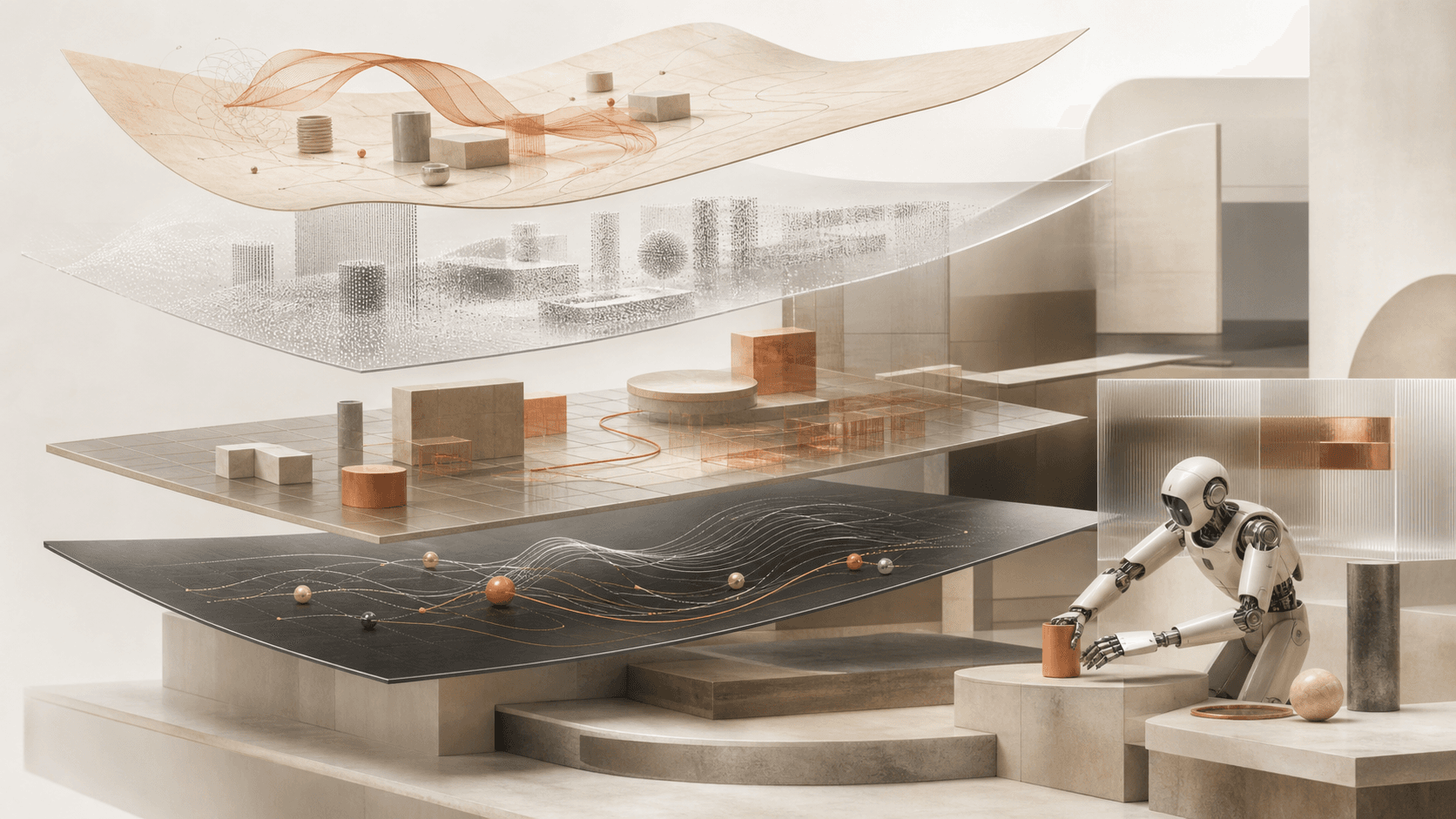
VLA is one learned layer within a larger system of context, planning, control and physical feedback.
- 01Language / Vision contextLLM · VLM
- 02VLA / Policy layermultimodal action mapping
- 03Planningtask decomposition · sequencing
- 04Controllerfeedback · dynamics · safety
- 05Actuator / Physical feedbackmotion · contact · state
- 06Architecture variesVLA is one layer, not the entire robot system
VLA vs Traditional Robotics
Traditional modular systems usually rely on explicit interfaces, task-specific engineering, and carefully defined operating conditions. VLA-enabled systems use learned multimodal representations and may generalize more flexibly, but their behavior depends on data, embodiment, evaluation, and safeguards.
The practical comparison is not “old robots versus intelligent robots.” It is how much of the task is represented explicitly, how much is learned, where uncertainty is handled, and how the final action is verified before reaching the hardware.
Current Research Directions
Robot data
Robot learning needs data that connects observations, instructions, and physical actions. Open X-Embodiment studies shared data across many robot platforms, while DROID illustrates the cost and diversity requirements of real-world manipulation data. [RP-VLA-05] [RP-VLA-08]
Imitation and reinforcement learning
Imitation learning uses demonstrations. Reinforcement learning improves behavior through reward or feedback. They are training approaches, not synonyms for VLA, and a system may combine them in different ways. OpenVLA and generalist policy work show how demonstrations can support adaptation. [RP-VLA-03] [RP-VLA-06] [RP-VLA-07]
Simulation and sim-to-real
Simulation can provide scalable practice and synthetic data. Domain randomization is one transfer strategy, but real contact, friction, sensing, latency, and object variation still create uncertainty. [RP-VLA-09]
Cross-embodiment learning
Researchers are testing whether skills transfer between different robot bodies. This is an evaluated property, not an automatic consequence of using a VLA architecture. [RP-VLA-05] [RP-VLA-06] [RP-VLA-10]
Reliability
Reliable systems must handle ambiguity, occlusion, unexpected objects, recovery, long-horizon error accumulation, and human intervention. Benchmark success alone does not establish reliable operation.
Representative Systems
RT-2 is a Google DeepMind research system that connected web-scale vision-language pretraining with robot control, helping establish the VLA category. It is a research result, not commercial deployment evidence. [RP-VLA-01]
OpenVLA is an open-source 7B VLA trained with large-scale robot demonstrations. Its contribution is an open research model and adaptation workflow, not proof of a universal production controller. [RP-VLA-03]
Physical Intelligence’s π0 is a research VLA flow model for general robot control across multiple platforms. It demonstrates a different action-generation approach, not a deployed robot fleet. [RP-VLA-10]
Figure describes Helix as a VLA for generalist humanoid control, while Google DeepMind describes Gemini Robotics as connecting visual understanding, language, and physical action. These are company-reported technical claims and should not be treated as independent deployment validation. [RP-VLA-11] [RP-VLA-12]
NVIDIA describes GR00T N1 as an open foundation model for humanoid robots using real, simulated, and synthetic data. A public model announcement is not the same as scale deployment. [RP-VLA-13]
Limitations and Open Problems
High-quality robot data is expensive to collect, clean, and align with language. A policy trained on one embodiment may not transfer to another because kinematics, sensors, grippers, payloads, and workspaces differ.
Simulation reduces training cost but cannot perfectly reproduce real contact and sensing. Long-horizon tasks accumulate errors, and a plausible action can still be unsafe. Production systems therefore need monitoring, constraints, recovery, human intervention, and low-level control protection.
Conclusion
A Vision-Language-Action model connects instructions and visual observations with robot behavior. Its output may be a token, pose, waypoint, trajectory, or action vector—not necessarily direct motor torque.
VLA research offers a path toward more flexible learned policies, but reliable physical AI still depends on data, embodiment-specific adaptation, planning, control, safety systems, and evidence from real operation.