Evergreen
What Is a World Model in Robotics? How Robots Predict What Happens Next
World models help robots predict how actions may change the physical world. This explainer covers learned dynamics, planning, latent prediction, simulation, VLAs, and the limits of predicting real-world outcomes.
- Published
- September 22, 2026
Key Takeaways
- A world model predicts how an environment may change, often in response to an agent’s actions.
- World models do not need to generate video; they can predict latent, visual-feature, or structured future states.
- World models can support planning, policy learning, simulation, and evaluation, but they do not eliminate real-world interaction.
- A plausible predicted future is useful only if it is accurate enough to improve decisions under physical constraints.
From Seeing the World to Predicting It
Imagine a robot arm facing a peg and a matching opening. A vision system may identify both objects, estimate their positions, and describe their shapes. Yet those observations do not by themselves say whether the peg will slide, catch on the rim, or enter the opening when the gripper moves. Seeing the current scene and predicting how that scene may change are different capabilities.
The distinction matters because a physical scene is not a still image. A small push can rotate an object; a grasp can fail if the surface is slick; contact can shift the fixture. For robots, the useful question is often not only “What happens next?” but “What happens if I do this?” The answer depends partly on the chosen action and on physical details that may be uncertain or only partly observed.
A world model is one way to learn and represent possible consequences of actions. It gives a robot or planner a predictive estimate to use alongside perception, control, and task goals; it is not a complete account of intelligence or a guarantee that a planned action will work. In the broader Physical AI system, it addresses one practical problem: estimating how the world may respond.
What Is a World Model?
A world model is a learned predictive representation of how an environment may evolve, often conditioned on an agent’s actions. In a robot setting, that environment can include objects, surfaces, the robot’s own body, and task-relevant relationships among them. There is no single architecture shared by all world models: researchers use the term for systems with different representations, training data, prediction targets, and connections to decision-making.
Some models predict future images or video; others predict latent representations, visual features, or structured state such as object poses and task variables. These are examples, not an exhaustive list. A system may also combine representations—for example, using visual features to predict motion without reconstructing every pixel. The word “model” therefore describes a predictive role more reliably than a particular output format.
A world model can inform action selection without being the policy that selects the action. A planner might query a predictive model to compare candidate actions, while a policy maps observations or states to actions directly. Real systems can integrate these roles, share parameters, or optimize them jointly, but the conceptual distinction remains useful: predicting a consequence and choosing what to do are related, not identical, tasks.
Why Robots Need to Predict the Consequences of Actions
Physical trial and error has practical costs. A robot may need repeated attempts to learn how much force moves an object, whether a grasp holds, or how a task changes when an object is offset. Each attempt consumes time and can require resets, operator supervision, or inspection of hardware and workpieces. In some settings, wear, fragile objects, or safety constraints also limit how many experiments are reasonable.
A learned predictive model can let a learning system test some candidate behaviors internally before spending another physical attempt. If its predictions are sufficiently useful for the task, that can reduce some physical trial-and-error. It does not remove the need for robot interaction: the model is learned from data, can be wrong outside the situations it has seen, and must be checked against real outcomes. Internal rollouts change where some experimentation happens, not whether physical validation matters.
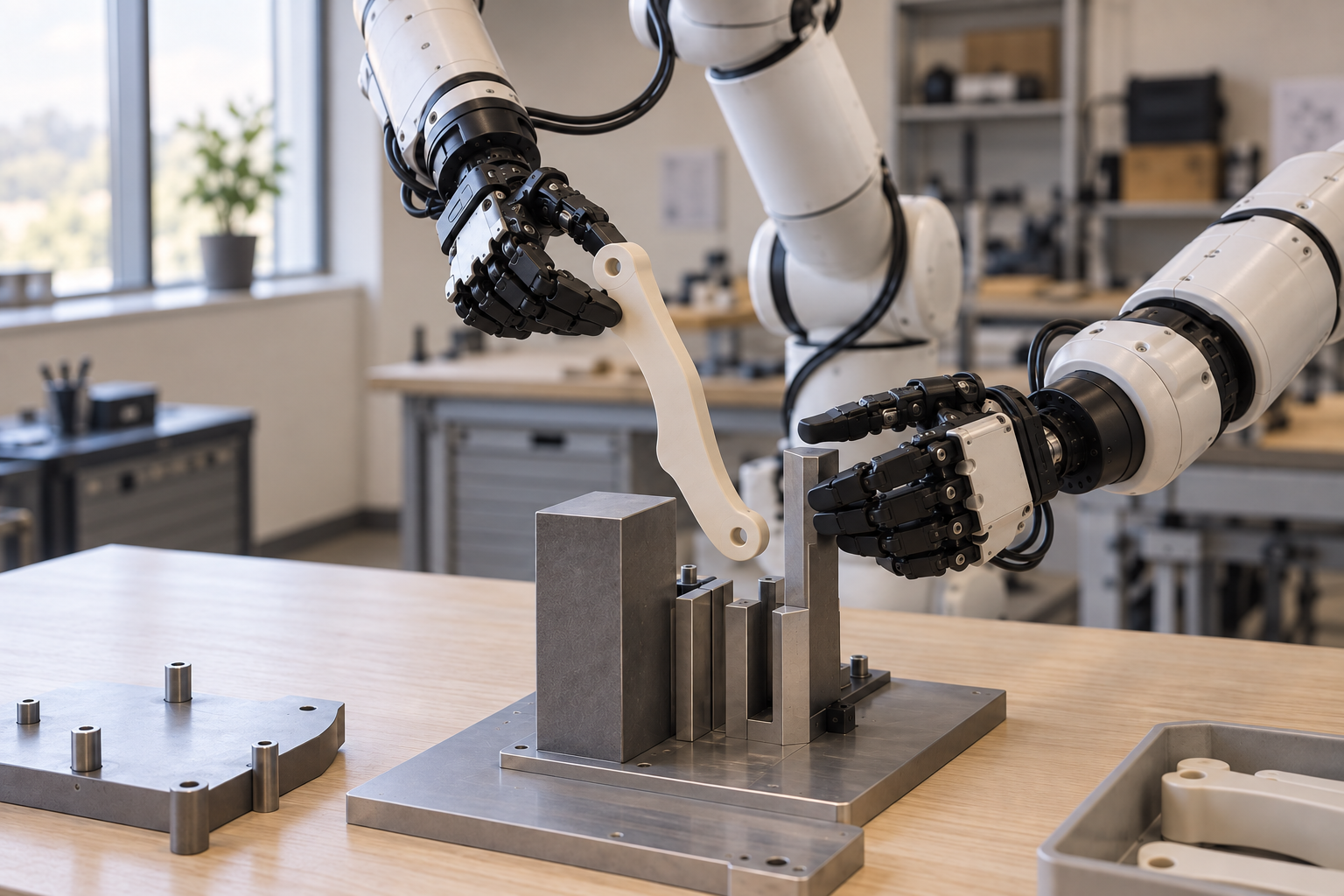
A robot may need to anticipate how an object will move before committing to a physical action.
DayDreamer is a direct physical-robot example. The researchers applied a Dreamer-based method to several robots, learning from real interaction while using a learned world model to predict action outcomes and improve behavior through imagined rollouts. Their reported tasks include locomotion, arm-based object handling, and wheeled navigation; these experiments illustrate a method and set of tasks, not a claim that all robot learning can be done this way. It connects to the broader practice of Robot Learning, where data, objectives, and feedback shape capabilities.
How a Robot World Model Works
The predictive process starts from some representation of what the robot currently observes or estimates. Depending on the system, inputs may include camera images, robot configuration, proprioception, learned visual features, or other sensor readings. A model need not receive every sensor or represent the whole world: it may focus on state variables that are useful for a particular task, such as an object’s pose relative to a gripper.
A teaching abstraction is: current state or observation plus a possible action, passed to a predictive model, yields an estimate of a possible future state. The action matters because moving left, closing a gripper, or applying more force can lead to different outcomes from the same starting view. This is a conceptual abstraction, not a universal architecture; systems differ in how they encode state, represent time, and connect predictions to planning or control.
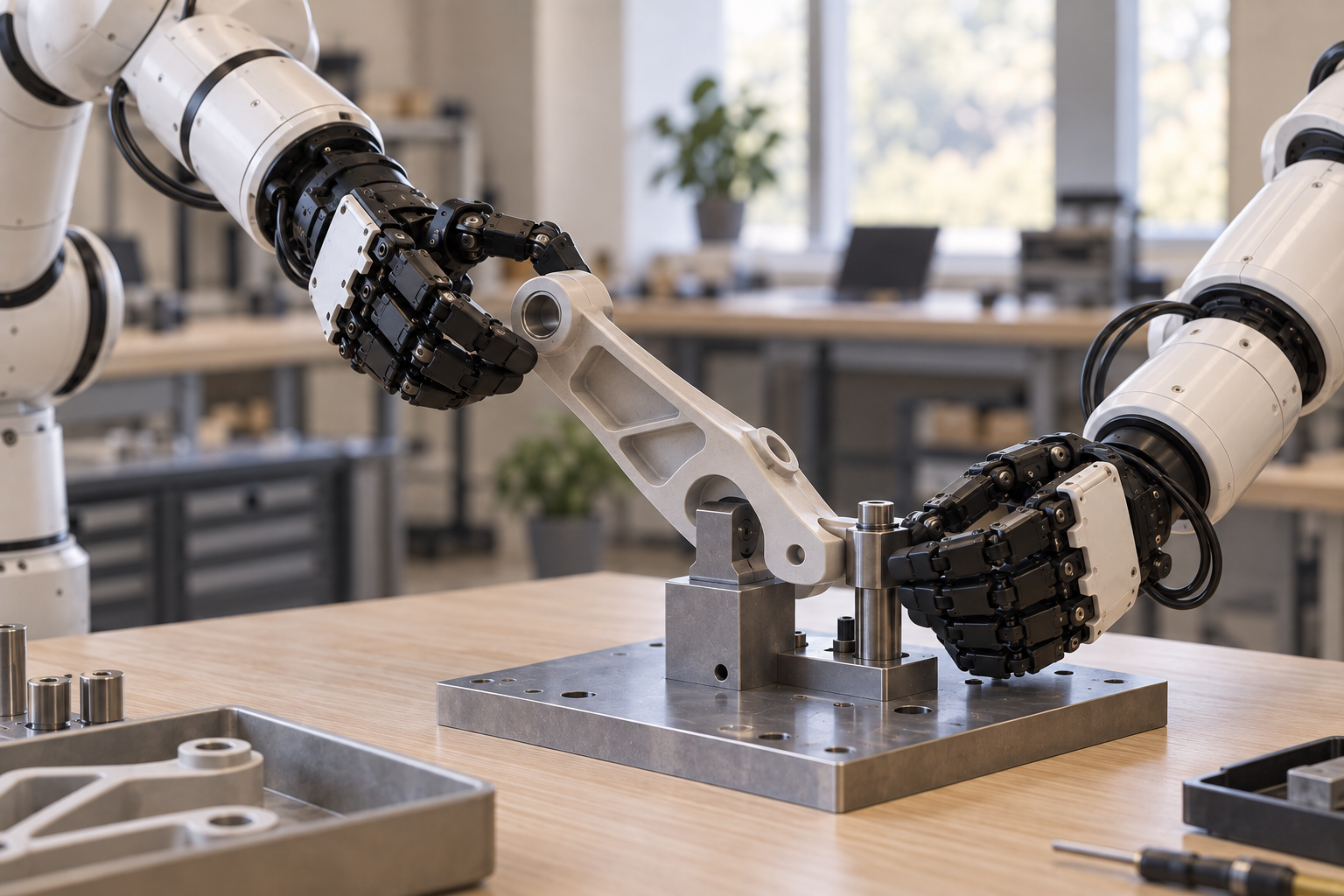
A useful world model must relate an action to how the physical state may change.
A useful world model does not have to generate photorealistic video. TD-MPC2 learns latent dynamics and performs local trajectory optimization in the latent space of an implicit model. DINO-WM predicts future pretrained visual features and uses action-sequence optimization for planning, without reconstructing the visual world pixel by pixel. These examples show that a predictive representation can support decisions even when its output is not a realistic rendered scene.
For multi-step planning, a system may feed one predicted state into the next prediction, producing an imagined rollout over several actions. This can help compare candidate sequences, but small errors may accumulate or send later predictions into states that were poorly represented in the training data. A planner may therefore favor short horizons, re-check the real observation, and re-plan. Such methods manage prediction limits; they do not make those limits disappear.
World Models, Simulators, VLMs, and VLAs
A simulator and a learned world model can serve overlapping roles without being the same thing. A simulator may combine explicit physical rules, empirical approximations, learned components, or a mixture of them. A world model is usually discussed in terms of a learned predictive representation, but it may itself be used as a simulation-like environment for planning or learning. The distinction is about how a model is constructed and used, not a simple divide between “coded” and “learned.”
A vision-language model (VLM) can connect visual input with language and may answer questions or produce descriptions about a scene. Action-conditioned dynamics modeling asks a different question: given a state and a possible action, what changes might follow? A VLM may also make predictions, and the categories can overlap in real systems; the distinction here is about the predictive role required for reasoning about action consequences, not a claim that VLMs cannot predict.
A vision-language-action model is often introduced through the teaching shorthand “observation plus instruction → action,” while a world model is often introduced as “state plus possible action → predicted future.” These are different roles, not competing definitions of an entire robot. A system may use a VLA to produce actions and a predictive model to compare outcomes, or combine the capabilities in another way. For more on the action-generating role, see Vision-Language-Action (VLA).
A Robot Foundation Model refers to reusable model capability intended to transfer across tasks, environments, or embodiments; a world model refers to prediction about dynamics and possible consequences. They are not synonyms. A Robot Foundation Model may contain or use world-model-like components, but that is not universal, and a predictive model need not be a broad reusable foundation model. The distinction separates a model’s intended scope from one function it may perform; see Robot Foundation Model.
How World Models Are Used in Robot Learning
One use is to improve behavior with imagined experience. In the World Models line of work, an environment model learns compressed spatial and temporal representations that can support policy training. DreamerV3 similarly learns an environment model and improves behavior by imagining future scenarios; DayDreamer applies this approach to physical robots. These systems do not imply human-like dreaming: “imagination” refers to computation over model-generated predictions rather than a robot having subjective experience.
A second use is planning. A planner can evaluate candidate action sequences against a learned predictive model and select a sequence expected to make progress toward a goal. TD-MPC2 performs local trajectory optimization in a learned latent model; DINO-WM uses predicted visual features and action-sequence optimization to pursue visual goals in its tested environments. These results are examples of particular research methods, not evidence that the same approach is reliable across every robot, task, or setting.
One recent survey of world models for robot learning groups roles such as policy learning, planning, simulation, evaluation, and data generation, while noting that the literature spans different architectures and functions. In practice, a learned predictive model can act as a partial simulation or evaluation tool: it may generate imagined experience for policy learning, compare candidate behavior, or test whether an action sequence appears promising under its own learned assumptions. That is narrower than a digital twin, which need not be implied by a predictive model; model-based evaluation still needs comparison with physical outcomes.
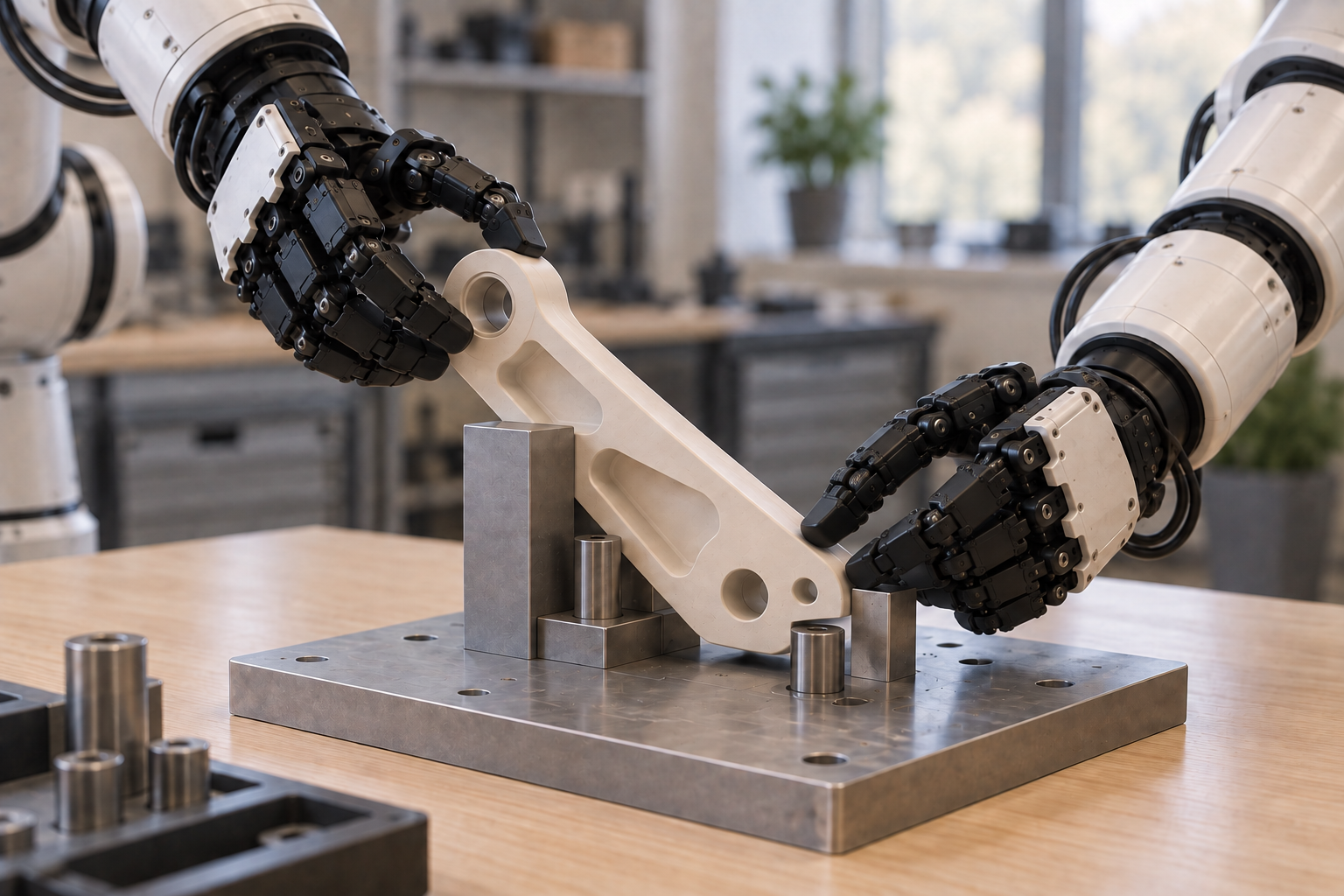
Real contact can reveal small differences between a predicted outcome and what actually happens, requiring the robot to adjust.
NVIDIA describes Cosmos as a platform of pretrained world foundation models that developers can adapt into customized world models for Physical AI applications. It is one current foundation-scale, generative direction, presented by a corporate primary source. That description is useful for understanding how the term is being applied, but it is not independent validation of general performance or proof that robotics has converged on a single world-model architecture.
What Current World Models Still Get Wrong
Prediction errors become more consequential as a planner looks farther ahead. A model that estimates the next frame or state reasonably well may still drift when its own outputs become the inputs to later predictions. Small timing, pose, or contact errors can compound, so success on a single-step prediction objective does not establish long-horizon reliability for control.
The same scene can also have several plausible futures. An object may slip or stay in a grasp; a mobile base may encounter a different patch of friction; a person or another robot may move. A model may return one likely outcome, a distribution, or several hypotheses, depending on its design. Any one forecast is conditional on the state estimate, action, and assumptions—it is not necessarily “the future.”
Contact-rich manipulation makes those limits tangible. A grasp can hold, slip, or collide; friction varies across surfaces; soft materials deform; small differences in geometry or force can change what happens next. A manipulation-focused survey treats world models in relation to task-relevant future prediction under robot intervention and identifies contact modeling and action alignment as continuing challenges. Models that average over such variation may miss a task-critical event. These issues are central to Robot Manipulation, where perception, contact, motion, and control have to work together under physical constraints.
Generating a plausible future is not the same as predicting the physical world accurately enough for control. A sequence can look coherent while getting contact wrong, showing an outcome that is not faithful to the action, changing object geometry inconsistently, or failing to preserve the details a controller needs. Visual realism is therefore not, by itself, evidence that a model’s predictions are useful for a robot’s decisions.
Robots still need feedback, evaluation, replanning, and testing in the environments where they will operate. Real observations can reveal when a prediction was wrong and support an updated plan or model, but changing hardware, objects, lighting, and contact conditions remain challenging. These transfer limits connect to Sim2Real; a world model may help reason about possible outcomes, while evidence from the physical system remains necessary.
Conclusion
A world model represents possible consequences of actions, but its architecture and prediction target are not fixed. It can support learning, planning, simulation-like experience, or evaluation, but generating plausible predictions does not by itself establish reliable real-world control. Its practical value depends on whether those predictions are accurate enough to improve decisions under the constraints of a real robot and its environment.