Evergreen
What Is Robot Control? From High-Level Commands to Physical Motion
Robot control turns desired behavior into physical action through feedback, motion and force regulation, predictive optimization, whole-body coordination, and learned components.
- Published
- September 29, 2026
Key Takeaways
- A high-level robot command is not yet physical motion; control turns desired behavior into commands the real system can execute.
- Robot control is usually closed-loop: sensors measure what actually happened, and the controller adjusts the next command.
- Contact changes the control problem, bringing force, compliance, and interaction dynamics into the task.
- Modern robot control can combine model-based, optimization-based, and learned components rather than following one universal stack.
From High-Level Commands to Physical Motion
A robot may receive a seemingly simple instruction: pick up the cup, place a component into a fixture, or move its hand to a target pose. A vision-language-action model or another policy may already produce an action intended to accomplish that task. But deciding what should happen does not by itself determine how the physical machine will get there, how its joints will respond to loads, or what it should do if the motion begins to drift from the intended behavior. A high-level action is not yet physical motion.
Between a task-level decision and physical movement, a robot may use several intermediate representations. A system might specify a desired end-effector pose, generate a trajectory, command joint positions or velocities, regulate forces, or directly produce lower-level inputs. These are useful ways to describe parts of a control stack, but they should not be mistaken for a universal pipeline. Real robot architectures differ in how planning, control, and intermediate interfaces are divided.
This is where robot control becomes central. Control connects desired behavior to what the physical machine is actually doing, then adjusts commands as the robot and its environment respond. In the broader Physical AI chain, control is one of the mechanisms that turns computation into physical execution: intelligence has to pass through real dynamics, contact, disturbances, sensing, and actuation before it becomes useful physical behavior.
What Is Robot Control?
Robot control is the process of turning desired behavior into commands for the physical robot, typically using feedback to reduce the difference between intended and actual motion, force, or interaction. That definition is deliberately broader than any one algorithm. Robot control is not synonymous with PID, torque control, or a single “low-level” module that occupies the same place in every robot architecture.
What a controller regulates depends on the task and the interface available to it. One controller may track joint positions, another may regulate velocity, another may command torques or forces, and another may coordinate several quantities at once. Motion control, force control, hybrid motion-force control, and impedance control are therefore related but distinct control objectives rather than interchangeable names for the same problem.
A controller is also not the same thing as an actuator. Control computes or regulates commands; actuation produces physical effort. Depending on the system, the control interface might be a desired joint position, a velocity, a torque, or another reference passed to a lower-level loop. The robot’s actuators and mechanics ultimately turn those commands into physical effort and motion. The exact boundary varies across systems, which is another reason not to define robot control by a single output type.
Why Feedback Matters
Real robots rarely behave exactly like an ideal command suggests. A payload can change the required effort, friction can vary, a model can be imperfect, and delay, unexpected contact, or an external disturbance can push the system away from its intended motion. Even the robot’s estimate of its own state comes from measurements that can be incomplete or noisy. A controller therefore needs some way to compare what was intended with what actually occurred.
That comparison is the basis of feedback control. Sensors can measure quantities such as joint position, velocity, or interaction force, and the controller can use those observations to update subsequent commands. Robot control is usually a feedback process, not a one-time command. A simple conceptual loop is: desired behavior → controller → robot → sensors → measured behavior → controller again. This is a teaching abstraction rather than a claim that every robot uses the same software layout.
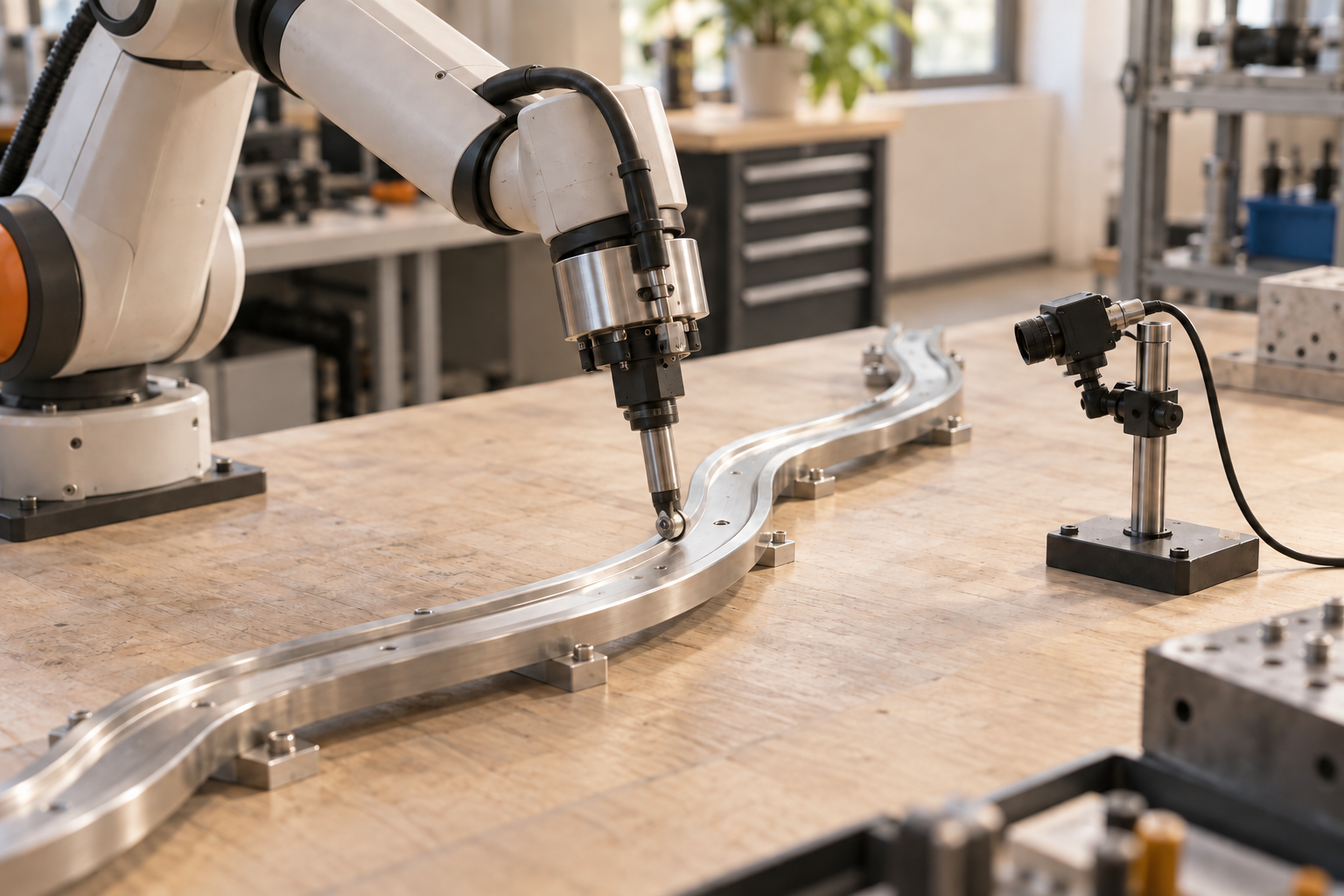
A feedback controller uses measured behavior to update commands as the robot tracks an intended motion.
The difference between a desired quantity and a measured quantity is often described as an error. If an arm is supposed to follow a trajectory but falls slightly behind, a feedback controller can change the next command rather than continuing as though the previous command had worked perfectly. The goal is not necessarily to make error literally zero at every instant, but to regulate the robot’s behavior so that its response remains appropriate for the task.
PID control is one familiar example of this logic. Roughly speaking, proportional action responds to the current error, integral action accumulates persistent error over time, and derivative action responds to how the error is changing. Practical robot controllers may combine these ideas with feedforward terms, dynamic models, optimization, or other methods. PID is one familiar family of feedback controllers, not a definition of robot control.
From Task Goals to Joint and Actuator Commands
Many robot tasks are naturally expressed in terms of what the end effector should do: move the hand to a pose, keep a tool aligned with a surface, or apply a force in a particular direction. These are task-space or operational-space descriptions. They refer to variables that are meaningful for the task rather than immediately specifying what every individual joint should do.
The robot can also be described in joint space, using the configurations and motions of its individual joints. Task space and joint space are therefore different descriptions used for different purposes, not interchangeable representations of all the same information. An end-effector pose may be intuitive for specifying a task, while joint coordinates describe the robot’s internal mechanical configuration more directly.
Inverse kinematics connects part of this gap, but it is not itself robot control. It asks a geometric question such as which joint configuration could place the end effector at a desired pose. Inverse kinematics describes geometry; control deals with how the real robot behaves over time. Reaching that pose in practice can also depend on velocity, dynamics, disturbances, feedback, actuator limits, and contact with the environment.
Operational-space control provides a useful example of how control objectives can be formulated around the task itself. Khatib’s operational-space formulation develops motion and force control in terms of end-effector dynamics and constrained interaction rather than treating joint coordinates as the only meaningful objective. That does not remove joints or actuators: the task-space objective still has to be realized through the robot’s physical dynamics, joints, and actuators.
Motion, Force, and Impedance Control
When a robot moves through free space, the main control objective may be to follow a desired pose, velocity, or trajectory. A manipulator can be asked to move its end effector from one location to another while feedback keeps the motion near the intended reference. But moving through free space and physically interacting with the environment are not the same control problem.
Contact changes the control problem. During insertion, wiping, polishing, pushing, or grasping, being geometrically “in the right place” may no longer be enough. Interaction force can determine whether the task succeeds, slips, jams, or damages an object. This is one reason robot manipulation cannot be understood only as a problem of moving a hand to a coordinate.
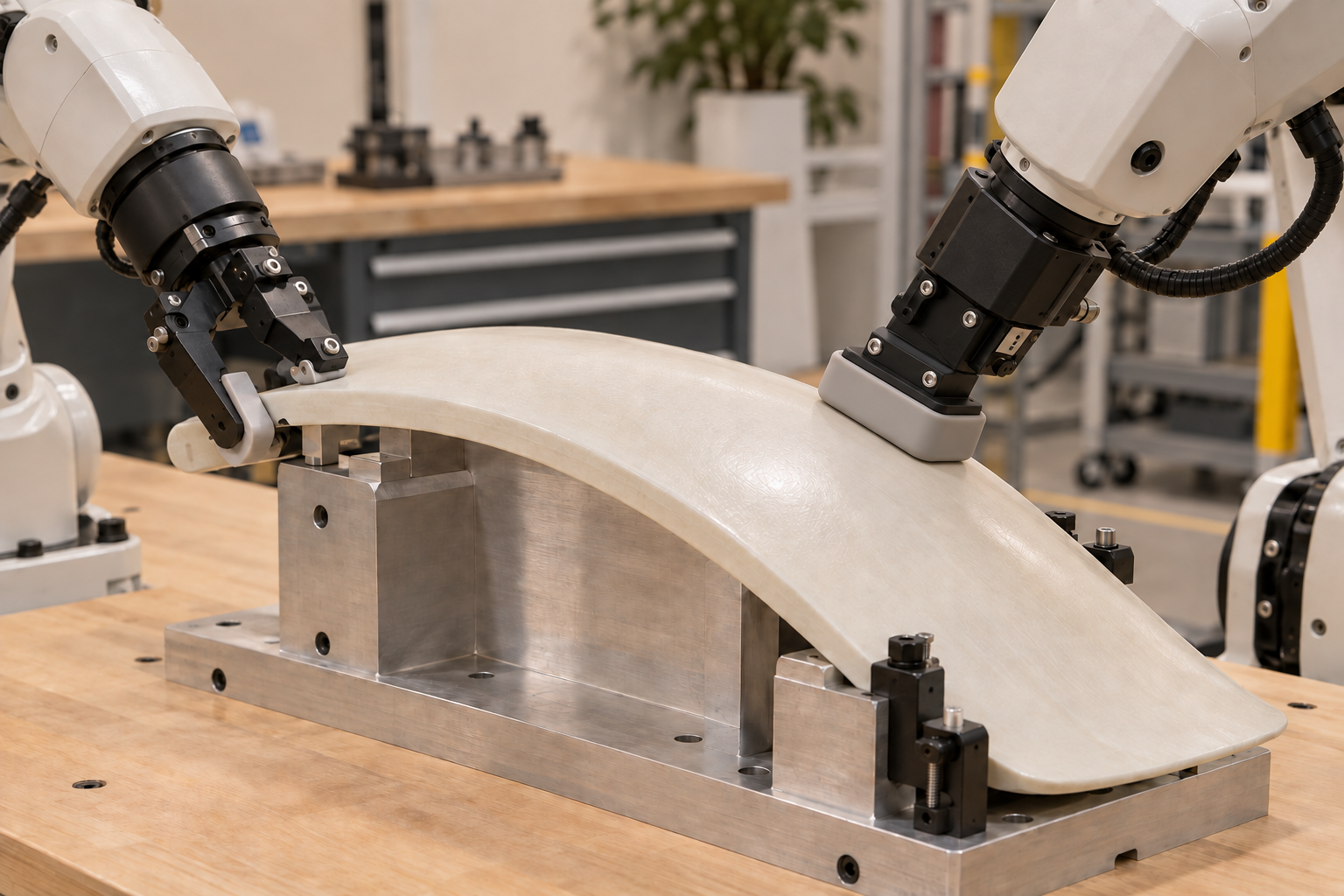
Once contact matters, successful control may need to regulate interaction force as well as motion.
Hybrid motion-force control makes the distinction explicit. In directions where the robot is free to move, the objective can focus on motion; in directions constrained by contact, the relevant objective can instead be a desired force. A single contact task can therefore require motion regulation and force regulation at the same time, rather than switching completely from one to the other.
Impedance control addresses interaction from another angle. Impedance control shapes the dynamic relationship between motion and interaction force rather than specifying motion or force in isolation. Intuitively, the controlled robot can exhibit different effective stiffness and damping, allowing more or less compliant responses when external forces act on it. Hogan’s classic formulation emphasizes that manipulation mechanically couples the robot to its environment, so the dynamics of that interaction can itself become a control objective.
Planning, Policies, and Model Predictive Control
Planning and control are useful concepts to distinguish, but the boundary is not absolute. As a simplified description, planning considers candidate paths, states, or action sequences over some future horizon, while control regulates what the physical system actually does as it evolves. In a real architecture, optimization, replanning, trajectory generation, and feedback may be tightly coupled rather than implemented as cleanly separated boxes.
A similar distinction applies to policies. “Policy” describes a mapping from information to action; “controller” describes a role in regulating physical behavior. A VLA or another learned policy may produce a relatively high-level action, but a policy can also output joint targets or lower-level commands and thereby occupy part of the control stack itself. The terms describe different concepts, not permanently fixed levels of abstraction.
Model predictive control, or MPC, shows why these boundaries can overlap. An MPC system repeatedly uses the current state and a model to predict behavior over a limited horizon, optimizes a sequence of candidate controls, executes the immediate control action, and then solves the problem again using updated feedback. MPC is one example of planning-like optimization operating inside a feedback loop. In the MIT Cheetah 3 work, convex MPC was used to determine ground-reaction forces for a torque-controlled quadruped and evaluated on the physical robot.
The predictive model inside MPC should not automatically be called a world model. Classical MPC can use a task-specific mathematical dynamics model. In Ha and Schmidhuber’s World Models, by contrast, the model learns a compressed spatial and temporal representation of the environment and can support imagined rollouts for policy learning. Both involve predicting how a system may change, but they represent different modeling choices and research contexts.
Whole-Body and Learned Control
As robots gain more degrees of freedom and more contacts with the world, control can involve several objectives at the same time. A system may need to move one hand, maintain stable support contact, preserve balance, avoid joint limits and collisions, and keep a useful overall posture. These objectives can interact or conflict, so controlling one end effector in isolation may not be enough to describe the full physical problem.
Whole-body control frameworks address this coordination problem by organizing tasks, postural objectives, contacts, priorities, and physical constraints across a high-dimensional robot. Sentis and Khatib developed a hierarchy combining task-oriented control with constraints and posture, while later constraint-consistent formulations address combinations of complex tasks, obstacles, balance, and multiple contacts. Whole-body control is especially relevant to high-dimensional, multi-contact systems, but it should not be treated as a synonym for humanoid robotics alone.
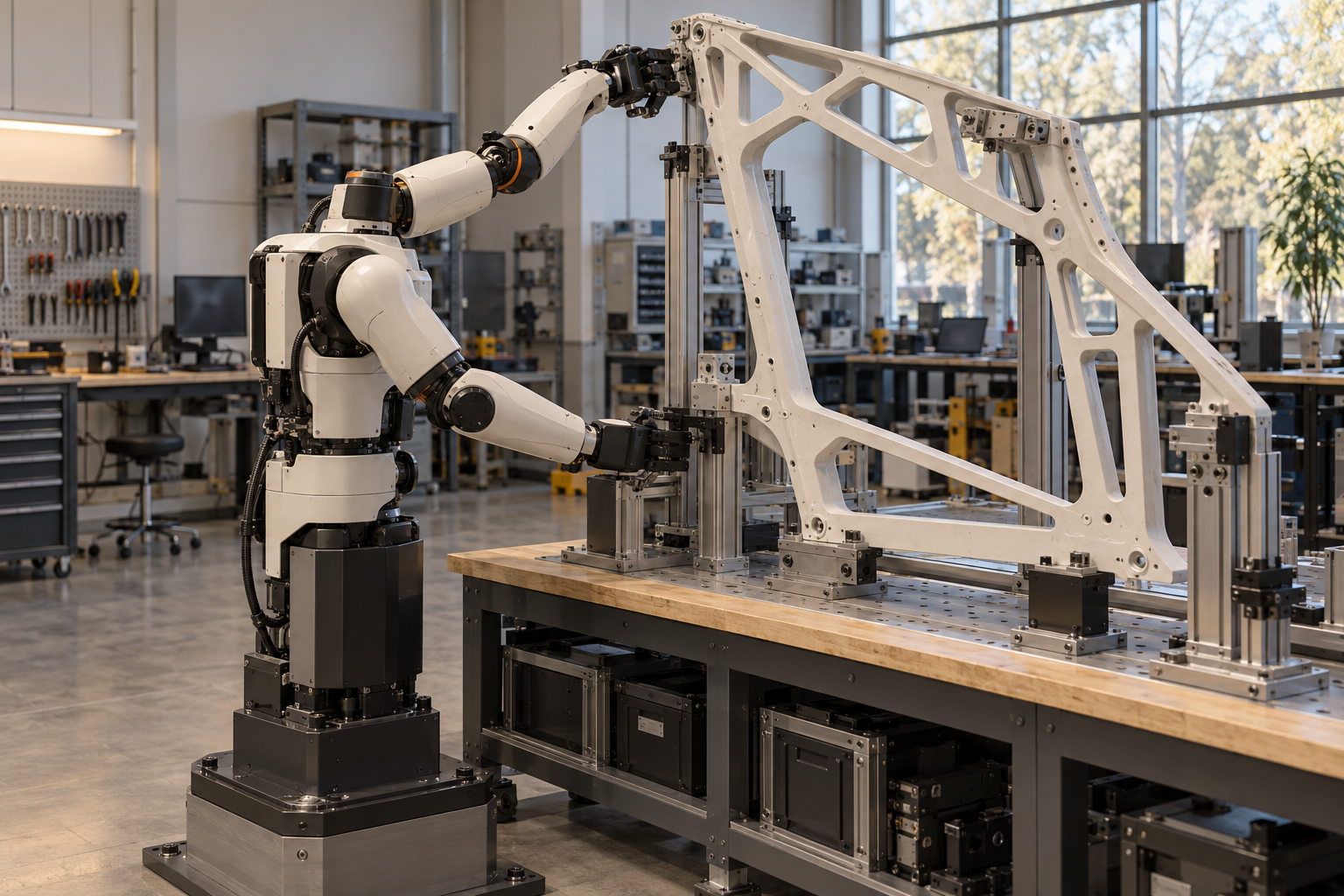
Whole-body control coordinates multiple tasks, contacts, and physical constraints across the robot at the same time.
Not every control mapping has to be hand-designed. Robot Learning can produce policies that take on meaningful roles inside a motor-control stack. Hwangbo and colleagues, for example, trained neural-network policies in simulation and transferred them to the real ANYmal quadruped, where the robot followed high-level body-velocity commands and performed locomotion behaviors on hardware. That result demonstrates one successful learned-control approach for the tested system; it does not establish that a neural policy universally replaces all other control components.
Modern robot-control stacks can therefore combine model-based feedback, optimization, learned policies, and lower-level loops, with the division of responsibility chosen for the machine and task. A learned policy can occupy part of the control stack without making feedback, physical constraints, or real-world validation disappear. This connects control directly to Sim2Real: a policy or controller that works in a model or simulator still has to cope with the dynamics, delays, sensing, contacts, and hardware of a real robot.
Conclusion
A high-level decision does not move a robot by itself. Control connects desired behavior to measured physical reality and continually regulates what happens next. The quantities that matter can change with the task: free-space motion emphasizes tracking, contact can introduce forces and interaction dynamics, and high-dimensional robots may need to coordinate several objectives and constraints at once. Modern systems can combine model-based, optimization-based, and learned methods rather than following one universal stack. For Physical AI, high-level intelligence ultimately has to be translated through control into reliable behavior in the physical world.